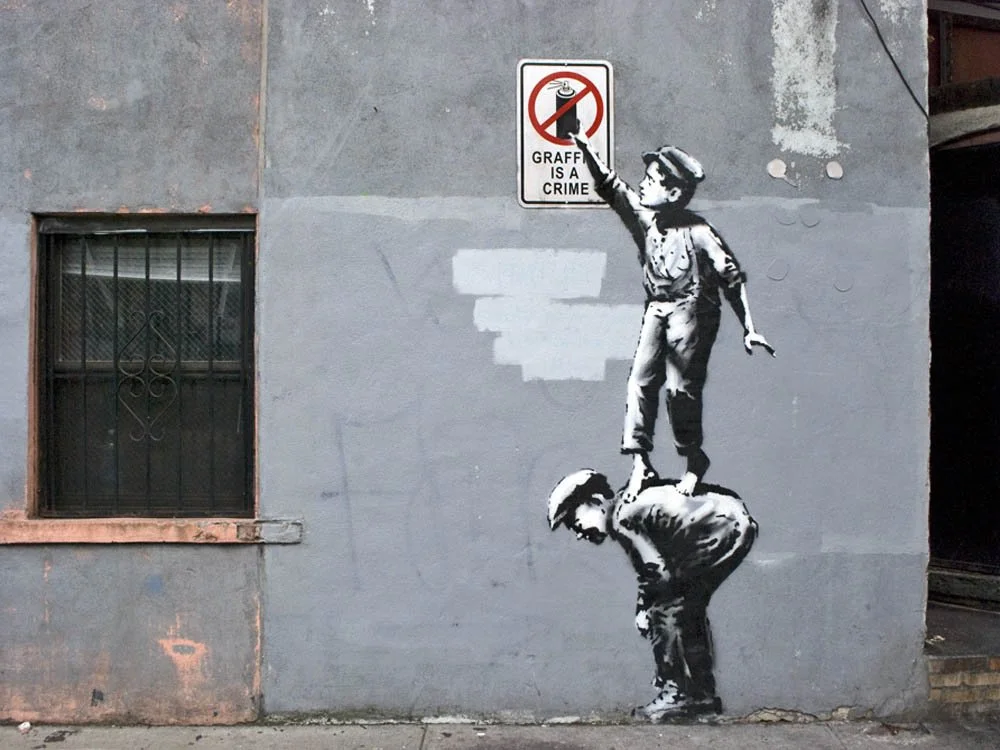
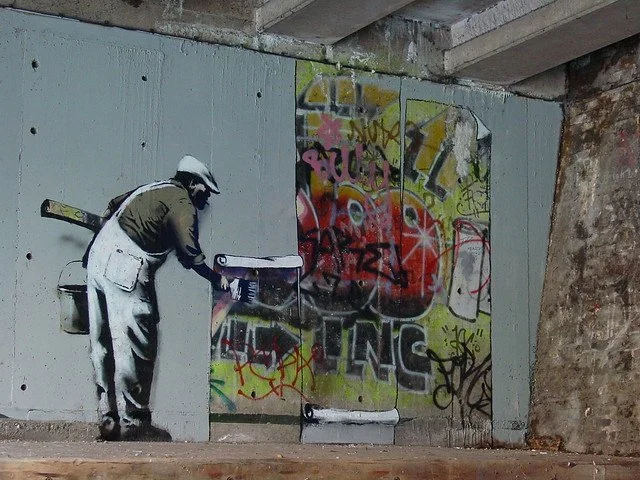
What do you see in this photo? Do you recognize the artist?
Unfortunately, I can’t hear your answer, BUT I’m willing to bet you recognized Banksy. Whether you find it beautiful or not, and despite made without permission, I imagine you think it’s a piece worth preserving.
It would be a shame if someone painted over it, right?
Well, let me tell you that is exactly what Banksy is doing on this wall: purposely erasing a piece of London’s street art legacy and sparking a literal war between himself and the urban art community. It caused international retaliation and a rivalry with a street art legend: King Robbo, the artist behind the work erased.
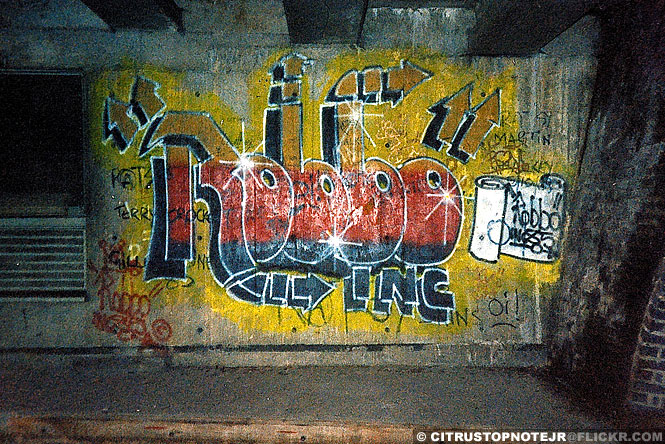
The unknown legend, King Robbo.
Many people don’t know him, but King Robbo is a true graffiti pioneer.
In the mid-80s, at just 15 years old, John Robertson—better known as Robbo—hit the streets. Art was always with him; it wasn’t just a hobby or a lifestyle, but an escape and a way to socialize after being kicked out of his home and school 1.
Over the years, he became a “heavy hitter” in the London scene, painting tunnels and trains, becoming almost omnipresent in the English capital before expanding to the rest of Europe and the USA.
At its core, graffiti is a punk movement of anti-system rebellion. It’s dirty, it’s dangerous, and above all, it’s illegal. As time passed and his children were born, Robbo decided to “retire.” However, he still hung out with artists and crews. It was during this time that he bumped into Banksy at the start of Banksy’s career.
Upon introducing himself, Robbo received a dismissive “never heard of you” from the up-and-comer. Things got heated, and the interaction ended with Banksy getting slapped.
A brawl for the wall
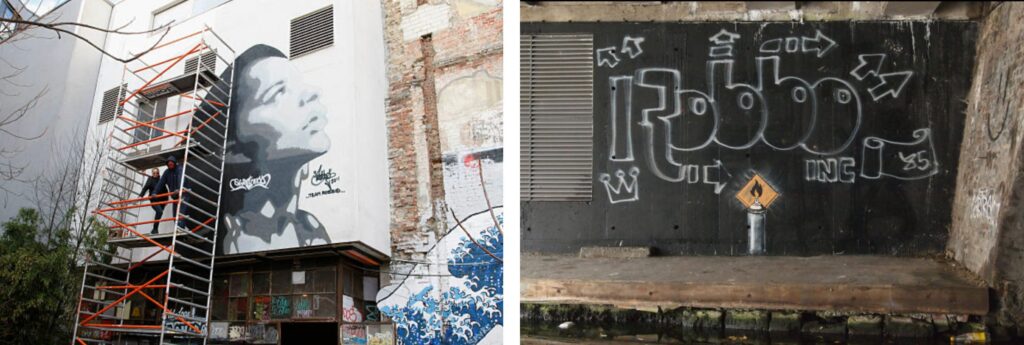
Time passed, and Banksy, now a global star with a bruised ego, decided to up the ante. He went to Regent’s Canal and covered Robbo’s oldest surviving piece, which had stood there since 1985.
And that’s when it all started.
What followed was a game of tit-for-tat, with Robbo and Banksy painting over each other repeatedly. Robbo discussed the feud in interviews after the first “overwrite” and again after the “Top Cat” piece, revealing that while this was just a wall hidden from the public, it represented a deep personal rift.2.
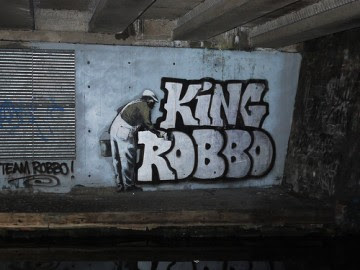
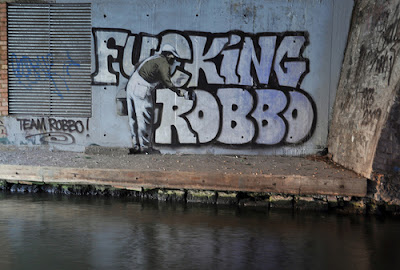
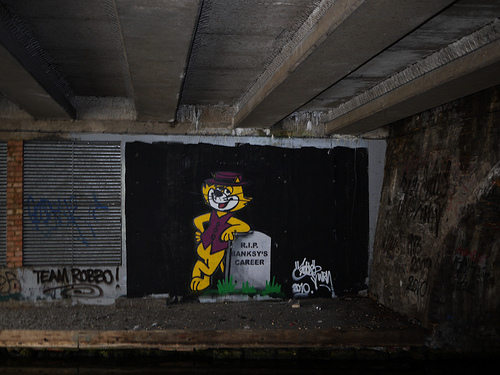
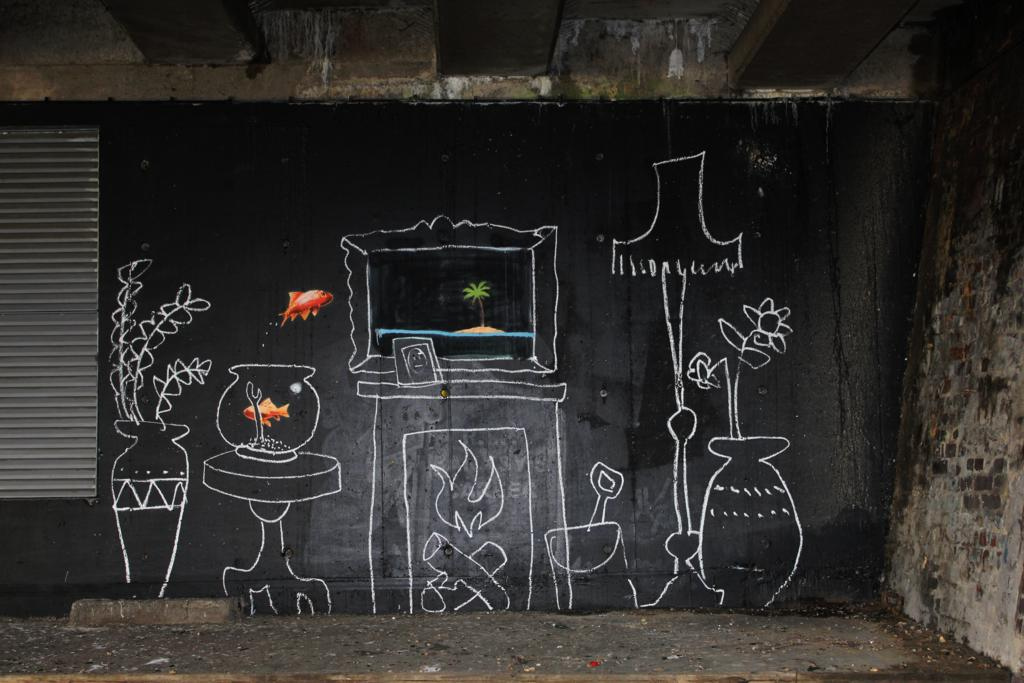
Others saw this, and the community joined in, creating a wave of interventions across the city. “Team Robbo” became a tag of solidarity, and various works were modified.
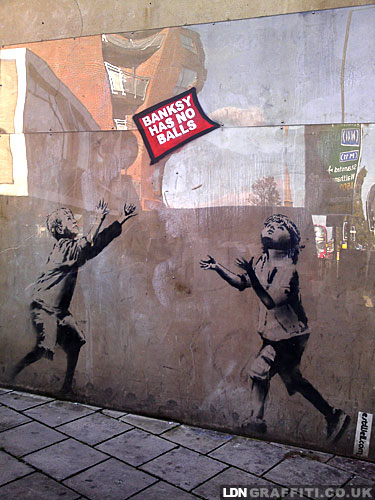
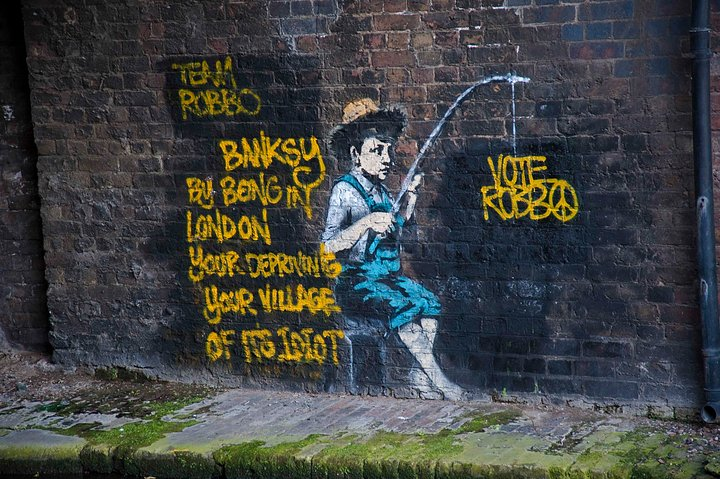
From criminal to Artist
In the middle of the crossfire, the ‘vandal’ became a star. The irony is that by trying to erase Robbo, Banksy ended up shining a massive spotlight on his rival’s career. Suddenly, Robbo was famous. The guy who used to run from the police was holding his first exhibition, selling canvases for thousands of pounds, and getting invited to galleries and film productions.
What was once vandalism began to be seen as “artistic intervention.”
Unfortunately, not all stories end well.
At the height of his fame, Robbo suffered a severe accident at his home and fell into a coma, passing away a few months later. In a show of solidarity, Banksy returned to the famous wall and painted a tribute using Robbo’s original outline.
What is art?
At the end of the day, this story wasn’t just about a wall—it was about culture, respect, and community.3.
This forces us to ask: Who gets to decide what is art and what is vandalism? There is no answer, but maybe one is money. When Banksy paints a wall, the property value skyrockets. The building owner slaps a sheet of protective glass over it and calls it an “investment.” When a kid from the suburbs does the same thing, it’s called “blight,” and the council sends someone to scrub it off.
Graffiti doesn’t ask for permission. It doesn’t care about looking pretty on Instagram, and it definitely doesn’t need to be accepted to exist because it wasn’t made to be liked; it was just made to be.
Bibliography and other cool content
There are a lot of cool content about this, here are some of the resources we used to make this text:
- A interview with Robbo.
- Grafitti Wars. A documentary about this rivary
- A really cool documentary on different interviews views on grafitti
Robbo gave some interviews alongside this rivalry. These are some of his opinions:
- “I got kicked out of school, and then home, it was hard back then. Graffiti art was a release for me. It was more to me than just writing. I loved developing the London style, I was really into abstract fills and blends rather than the letters” ↩︎
- “OK, when Banksy done the Wallpaperer, I understood why, because of what I said in London Hand Styles, I understand he may have been a bit hurt. All his supporters said it was the best thing he’s done in ages, it’s OK, it’s good, but, if he had just left the little scroll on the right visible I wouldn’t of had a problem with it. I painted that spot 25 years ago.”
“So he’s put fuel on the fire again, i’d left it since September last year, when i did Top Cat. It was about making a statement for graffiti writers, I had to do it. I had my gallery show last year, I made no reference to Banksy. The ‘Lips‘ I had painted before, at Alexandra Palace, before I used them on Banksy. They’re about ‘Rock and Roll’ not him, that’s what that’s about, I incorporated them into a couple of Banksy’s because that was graffiti, again that’s ‘Rock and Roll’ too!”
“After what’s happened, well, he didn’t have to pick that wall, there’s plenty out there, he didn’t have to go over my piece again. So he’s called it back on, yeah, i’ll reclaim it and a few more. Even if it is just a big silver dub under the perspex…” ↩︎ - “To all the guys that show support by putting up Team Robbo. I really appreciate it, it’s lovely it’s my name, but Team Robbo is not about me, It’s about us, graffiti writers, freehand graffiti, that’s what Team Robbo stands for. Anyone can write it, as long as you respect and appreciate real graffiti artists and writers, the fundamentals of graffiti and what it stands for. Nobody has to ask. It’s not for stencilling, wheat-pasting or modern street art. It’s the old values mixed in with the new school style. You don’t even have to be a writer! as long as you understand it and appreciate us for what we are. It’s not about doing something arty or to make a statement. It’s about the rawness of graffiti, being creative with letters and a spray can. Be radical! That’s what Team Robbo, and what graffiti is!”
↩︎